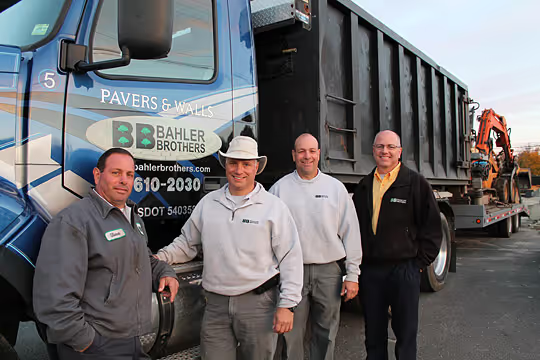
The Bahler Brothers forged their way to efficiency creating hardscape tools when there were none and customizing equipment.
Twenty-seven years ago when the 4 Bahler Brothers started their hardscaping business, there weren't any industry best installation practices because there wasn't yet a hardscape industry. Certification programs wouldn't become available for years.
With few resources to rely on, they made things up as they went. Phil Bahler says, "When we started we had to do a lot of things the hard way. So the 4 of us brothers got in the habit of always thinking how we could work better and faster."
Tom Bahler adds, "When you get 3 owners in the shop in the winter [Tom is in the office] and there's steel and torches and welders and grinders, they start making things to help them in the field."
Over the years they developed dozens of tools and modifications to trucks and trailers. About 6 years ago Phil showed a bunch of their tools to Techo-Bloc, and a partnership called Techo-Tools (techo-tools.com) was born to market 13 of their most popular tools. Techo-Tools remains a sideline to the Bahler Brothers contracting business. It is the quality and efficiency they gain from their tools, equipment, processes and people that is central to their success.
You must be that much better
Today, Tom says continually finding new efficiencies remains a necessity, but for additional reasons. They have to be able to cover the expenses of a larger company including 4 owner-level paychecks, benefits and salaries to keep highly skilled employees, office staff, facilities and a boat-load of equipment – and still remain competitive.
"A lot of competitors are working out of pick-ups. We cost more so we've got to be that much more efficient. And we talk to our guys about it a lot."
To help stay ahead of the curve, Bahler Brothers takes advantage of the educational resources that have become available. All 4 brothers and 7 of their employees are ICPI certified paver installers. The brothers and 5 employees are NCMA certified retaining wall installers.
Find your place
As a team, the brothers have been able to take innovations to a level not possible individually. Yet, one of the keys to making the business work has been to give each his own "kingdom."
Tom says, "We're the most efficient when just 1 of us is on the job at a time. 20 years ago all 4 of us would be on a job and we'd have 4 different opinions on how to get it done. We'd waste time debating."
They divided the business so each brother runs his own area. Tom runs the business/sales end of things in the office. Lloyd manages 1 or 2 dig-out crews (paver excavation and base prep) depending on the workload. Steve directs 3 or more paver installation crews. Phil is in charge of 1 or 2 retaining wall crews (including excavation and construction of steps and raised patios).
There's still a degree of overlap and coordination, and the brothers still talk and kick around ideas. But they also stay out of each others' area of responsibility as much as possible. Today, the challenge is working the brothers' adult children into the business.
Shut down 'The Morning Circus"
Tom says one area that everyone used to participate in was The Morning Circus. "We'd have 15 to 20 guys in there trying to find what they needed for the day. It just didn't make sense to take your tools off the truck every night, only to load them all up again the next morning. Something's wrong when you're paying someone for an hour every day just to load and unload."

Today, everything stays loaded. Vehicles are locked in their fenced-in yard. They're parked outdoors so most things that can't get wet go in tool boxes. Some wooden handled tools are stored outside, but Tom says, "We'd rather go buy a couple extra shovels and picks than have our guys hauling them in and out of the shop every day."
They no longer share tools beyond a few specialty items. Each truck is outfitted with everything they need so there's far less shuttling things between crews and far less coordination time. The only things loaded in the morning now are basic materials like sand, gravel or stone.
Tom says, "Foremen come in at 6:30am, the crews at 6:45am, and at 7am our trucks are rolling out of here. Back when we were loading and unloading, it was 7:30 to 7:45 before trucks left the yard. Multiply that by every day x 6 crews and it's a lot of wasted time."
The Bahler Brothers created a number of tools that increase efficiency because they allow workers to maintain a brisk pace without wearing down or getting injured. Minimizing lifting is a key to speed and to keeping trained employees from missing work.
Tom says, "We used to have guys argue they could haul pavers faster than a guy using paver lifters. That may be true at 8am, but by 3:30pm they're totally spent. The guy that's using the tool passed him at about noon and is still working nice and steady."
Phil says they saw the same thing installing retaining walls. "We used to lay 82 lb Versa-Lok blocks by hand. It was grueling. At the end of the day you're totally spent. Using a block clamp, you grab all 3 blocks from a pallet row at once. You've got one guy on the excavator, one guy on the pallet and one guy on the wall. Nobody's lifting them, and everybody's working fast and efficient to the end of the day."
The employee-tool relationship
Phil says their employees have really grown to appreciate tools. "When they come in after the winter break everyone asks what we invented this year. They know we came up with something to make their job easier. We have some laborers that have been with us 6 or 8 years and some foremen over 14 years. So, we're back operating near 100% efficiency in no time at all."
When you have less skilled employees, good tools let them do quality work in a short time. Phil says, "We want to be able to give a laborer a tool and a simple explanation that allows him to do a job as good as a craftsman."
But using some tools doesn't come easily to people. A lot of workers would rather just lift materials by hand than learn to lift with a tool. They'd rather get down on their knees to screed the way they've done it than learn to use a stand-up screeder that saves their back.
Phil says you have to push them. "A lot of it is the foremen and owner. They have to be on the same page and want to try to work with the new tools and enforce it. We've found that once we do that and our workers catch on, they won't go back to the old ways."

Paver dig-out crews each have a skid steer and a 39" vibratory roller (in addition to a plate compactor and rammer). The crew often brings a mini-excavator small enough to get thru a 4' gate to bury downspouts and things like that. The skid steer does the main digging.
The crew does enough large areas and walkways to keep the rollers busy every day. Even so, the company buys used machines to halve the cost to about $15,000 each. The rollers efficiently compact 8" lifts with 1 or 2 passes. Phil says, "The rollers level while they compact so it makes your base practically perfect and speeds up production."

Wall crew and dig-out crew trailers have built-in geo-textile dispensers. They install it on every job to separate soils from base aggregate. They cut a 12' 6" roll in 2 giving wall crews a 5' wide roll and dig-out crews a 7' 6" roll.
The division works out well. Wall trenches are normally 1' deep and 3' wide so the 5' fabric fits down one side across the bottom and up the other side.Dig-out crew skid steers excavate many 6' wide trenches for 4' walkways with their perfectly-sized 6' buckets. The 7' 6" geo-textile lets them cover the bottom of the trench and lap the sides. Phil says, "If you're doing a 100' walkway, you just grab the end of the fabric, pull it out 100' and cut it off."
Wall crew equipment

Retaining wall trailers carry a mini-excavator and a backhoe. The trailers have a rack at the front that holds 2 additional excavator buckets and a compactor. But no one lifts the compactor. They move it with the backhoe like they also move all their tools. The excavator uses a 3' bucket to dig wall trenches because they're typically 3' wide (1' block + 1' of base to the front + 1' of base to the back). The bucket has a flat blade (no teeth) so it won't disturb sub-soils. Their 9" and 24" buckets have teeth for more aggressive digging. The 9" bucket cuts narrow trenches for electrical conduit or drainage tubing. The 24" is general purpose.

The retaining wall excavator has a Wrist-O-Twist that lets you tilt your bucket sideways. "So I can always dig a level retaining wall trench – which is huge for quality. You always want your trench to be level with the top of your wall base," explains Phil.

The retaining wall backhoe has a side-dump, so you can drive along a wall and dump stone behind the wall as you go. It is used mostly as a front-end loader though it also has forks to move pallets and helps with digging if needed.
Paver crew tools & equipment


Paver crew trucks have 2 tailgates. The middle one, held in place by 4 pins, lets them separate materials. At day's end they might put scrap on one side and leftover sand on the other. Back in the yard, they dump the sand in the sand pile, drive to the scrap pile, unpin the center gate and dump the scrap. Phil says, "They're not dragging off scrap or shoveling sand or putting away tools at their least productive time of the day."
The back tailgate has a narrow "coal chute" in the center that lets them dump sand directly into wheelbarrows without an overflow mess. The sides of truck beds fold down to load pallets efficiently with forks. A headboard at the front of the dump holds each tool in place.

Paver installation trucks carry a compactor and compressor in a custom-made basket that locks into a fisher plow mount. They need this storage space because they don't have a trailer. They don't need a trailer because the dig-out crews do the equipment-heavy work of excavating and installing base.
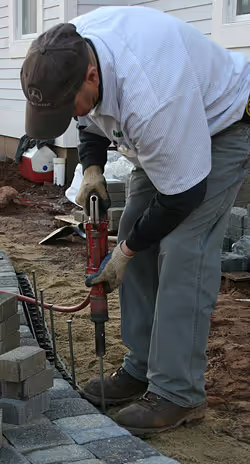
The compactor is stored on a hand truck, and wheels down the ramp. The air compressor also wheels down the ramp, but with 100' of hose it rarely comes off the truck. The compressor runs an air hammer drill with a special head the brothers developed for nailing in edge restraint spikes.
Project Profile
Company
Bahler Brothers, Inc.
Location
South Windsor, CT
Founded
1985
Key team members
Tom Bahler — Sales & Marketing Mgr
Lloyd Bahler — Dig-out Mgr
Steve Bahler — Production Mgr
Phil Bahler — Retaining Wall Mgr
Customer base
100% residential construction
Services
82% hardscape
9% softscape
5% lighting
2% water features
2% pergolas
Largest project
$120,000
Average project
$13,000
Annual sales
2011 — $1,981,379
2012 — $2.3 million projected
Employees
6 sales/administrative
15–18 field
There's more where that came from!
Sign-up for our free newsletter to get industry news, advice from experts and project features in your inbox.



.jpg)
.avif)