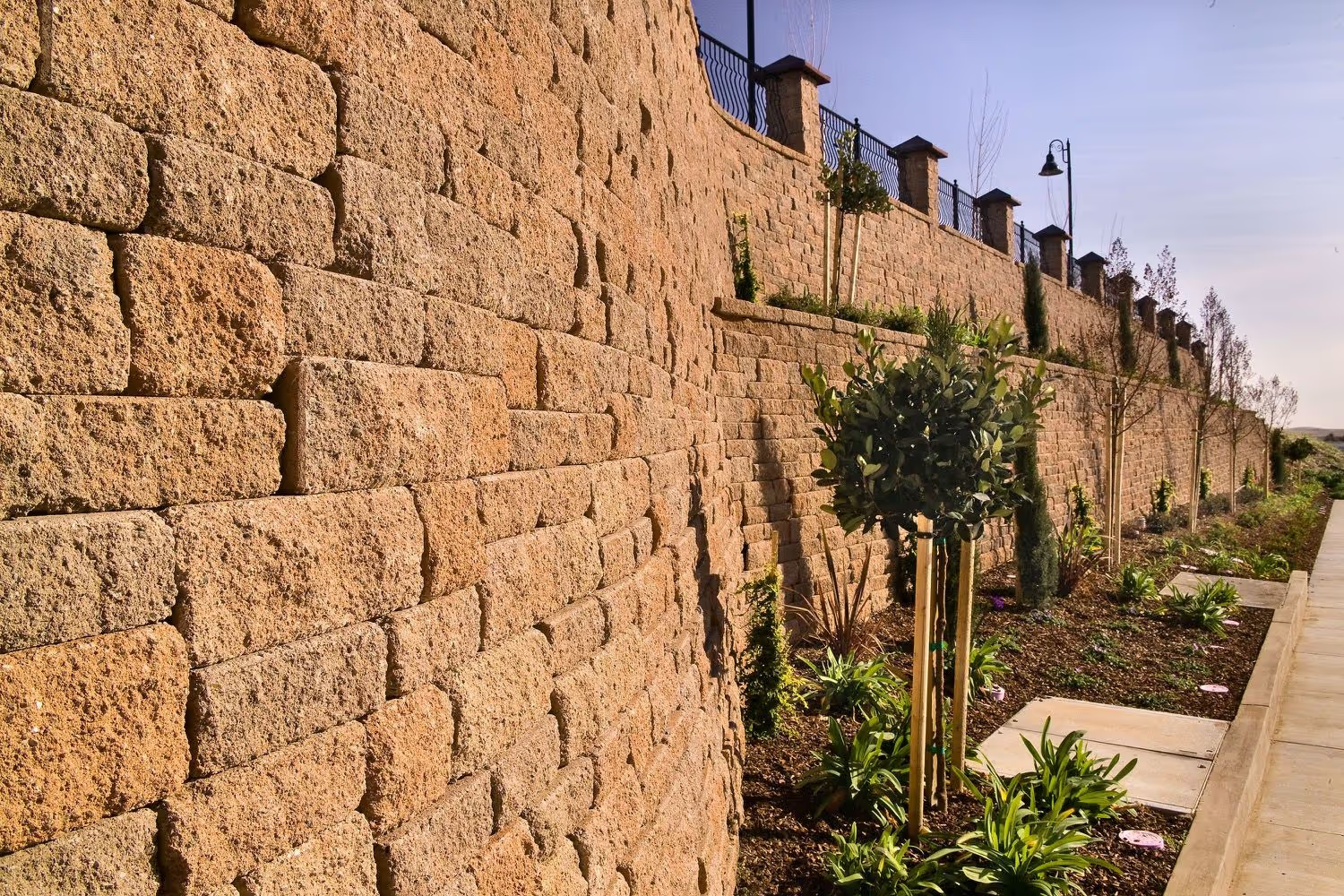
There are a lot of industry minimums in segmental retaining wall (SRW) installation. Minimums such as 6-6-6-6 for base – 6" beyond the heel of the block, 6" beyond the toe, 6" thick and 6" embedded. On a given job, engineers will up the minimums depending on soil bearing abilities, top and toe slope, live and dead loads, etc...
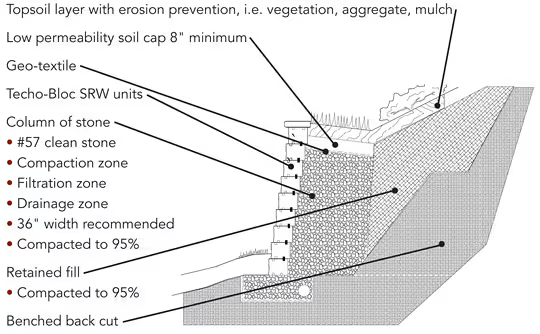
One SRW minimum should come with a caveat. As a critical component of the structure, I believe the column of AASHTO #57 clean open-graded stone directly behind the SRW units should read: 12" minimum, 36" recommended. Why? Among other things, you achieve excellent compaction with minimal effort, and you get better filtration and drainage. In my cost/benefit analysis, 36" has the advantage.

Less compacting, fewer man-hours
In real estate, it's location, location, location. In SRWs, it's compaction, compaction, compaction.
The #57 clean stone behind the wall achieves the required 95% proctor density upon being dumped without running a compactor over it. On the other hand, the retained fill in the Soil Reinforced Zone (SRZ) behind the column of stone does require compaction.
So, the greater the area filled with #57 clean stone versus retained fill soils, the less compacting you will have to do. Proper compaction is very labor and equipment intensive. You will need to compact in 8" lifts or less using light compaction equipment since you can't use heavy equipment within 3' of the back of the block.
To avoid wall failures, you must then measure to confirm you've achieved 95% proctor density. To do this right you need to do a nuclear density test to calibrate a dynamic cone penetrometer. Then you need to use the penetrometer to measure density of each compacted area after each lift. This isn't as complicated as it may sound, but it requires persistent quality assurance/quality control procedures be followed.
The column of #57 clean stone behind the wall requires none of the above. In 8" lifts, dump 36" of stone rather than 12" and your total compaction time is reduced.
Stone filtration beats fabrics
Geo-textile fabrics are an excellent separator of foundation soils from base material, and of low permeability clay fill from the column of clean stone. But the use of geo-textiles as a filtration medium between the column of clean stone and the retained fill (Soil Reinforced Zone, SRZ) needs more analysis.
While the use of geo-textile as a filter is widespread, there are recent concerns of geo-textile fabrics clogging and causing a buildup of hydrostatic pressure and creating lateral loads. So some contractors have gone back to using aggregates as a filtration medium the way they did before the advent of geo-textiles.
While it's still unclear which filtration method is best, it is widely accepted that #57clean stone has billions of receptor points, and at a 3' depth would take exponentially longer to clog than a fabric. It is also much easier to add soil at grade above the wall if there's minor settlement from soil migration into the stone (versus the removal of a clogged geo-textile fabric).
More stone, more drainage
Drainage is typically cited as the reason for the column of clean stone. Drainage is actually last on the list of reasons to use clean stone behind an SRW. It's last because every precaution should be taken to keep water from approaching the wall. A low permeability clay cap, asphalt, concrete, pond liner, drains, etc... should be used to redirect water away from the wall via a swale or berm.
If the surface water has been properly diverted, then our only concern is water present in the back cut – ground water. Even in the event of ground water at or above the foundation level, clean stone is a natural solution. Expanding the column of clean stone beyond the 12" minimum to the 36" recommended provides a tremendous amount of additional drainage area to prevent sediment and water from reaching the SRW units.
Benefits beat costs
Finally, the use of a 3' recommended column of #57 clean stone behind the wall must pass a cost/benefit analysis. Does its cost give the consumer the best value?
Benefits
- #57clean stone provides greater freeze-thaw resistance.
- Labor and compactor savings through less time spent compacting.
- No extra excavation needed; if excavating properly, following the angles of repose and OSHA bench-cut regulations, you will have room for 36" of stone.
- No geo-textile needed between the clean stone and the retained fill/SRZ.
- Unlike fill soils, #57 clean stone does not require an onsite storage area that's protected from the environment and that will also require repair to pre-construction site standards.
- You gain confidence in your warranty to the consumer.
Costs
- Cost to haul away excavated soils.
- Cost of #57clean stone (though cost is low).
From my cost/benefit analysis, the 36" recommendation makes more sense in the labor savings alone. Some additional analysis may be site specific. For example:
- Cut versus fill job
- Property lines
- Engineering recommendations
In conclusion, I believe the "12" minimum/36" recommended" depth for clean stone behind the SRW is a good conservative construction practice. If the SRW industry pie is to grow to benefit all of the parties, failures need to be minimized. So let's question everything, stop building walls using rules of thumb, start attending classes, do cost/benefit analyses, listen, think, argue, etc. to protect our chosen profession, and view our completed SRWs with pride.
Disclaimer: An engineered stamped drawing should be followed to the letter. Engineers take liability if the project is constructed to their specifications. If revisions or recommendations are proposed to the engineer such as 36" of clean stone behind the wall, they must be approved in writing.
Pete Baloglou is Techo-Bloc's North American Director of Education and Information. On Twitter follow Paver Pete@techobloc. Email paverpete@techo-bloc.com. Visit techo-bloc.com.
Project Profile
There's more where that came from!
Sign-up for our free newsletter to get industry news, advice from experts and project features in your inbox.


.jpg)

.avif)