.avif)
My father always told me that there is a tool for every job. I couldn't agree more. I will even go as far as to say that if you have the right tool, you could almost do any job. I think all of us at some point have spent an hour doing a job that could have been done in a minute with the right tool. And during that hour we probably broke the wrong tool we were using and got hurt in the process.
In our business, our biggest variable is labor. Our cost for labor goes way up when employees waste time trying to do something with the wrong tools. The most efficient way to complete each task we face without sacrificing safety or quality requires using the proper tools.
When I go to a site to evaluate a contractor's efficiencies, I focus on these 3 tasks: pulling pavers, moving materials and installing base. And, yes, time and again I see time wasted using the wrong tools.
Pulling Pavers

Paver Extractor
The screwdriver is the jobsite favorite for pulling pavers improperly. It usually takes 2 people. One will work the screwdrivers, and one will pound around the paver loosening it up and then trying to grab it real quick before it drops back in place. The paver edges get all chipped up and screwdriver gets wrecked.
I've seen other guys drill a hole in the paver, insert a "molly" and a screw, and pry the paver out. I have even observed guys remove a paver by smashing it to bits and then removing the pieces.
How many precious man hours are being wasted? You can purchase a paver extractor for $150 - $200. This single tool will save you a ton of time. If you are serious about doing pavers efficiently, make the investment.
Moving Materials
Let's talk about moving materials around on site. Assume you're on a job where the homeowner will not allow the Moffett to drive on their pristine lawn. He won't even allow the machine on his concrete driveway. Instead, the curb is the closest you can have materials delivered.
Now what? I have seen guys cut the bands and carefully stack a half band of pavers in the wheelbarrow and wheel them into the back. Once there, they unload the wheelbarrow and carefully stack them again. Or, most likely, the setter will have the laborer feed him pavers straight out of the wheelbarrow so he doesn't have to move.
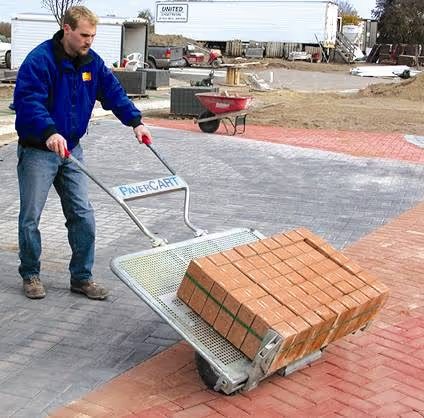
Paver Cart
When the wheelbarrow is empty guess who gets to sit and do nothing while the laborer reloads. The setter! As this goes on all day the laborer gets angry and starts to slow down. At day's end the laborer has exerted far more effort than was necessary. At the same time they didn't accomplish what should have been done that day.
The foreman gets mad because productivity is down and he is going to get yelled at. And sure enough the owner looks at the day sheets and says, "How come you didn't get this patio set today?" I will ask the owner one question: Have ever heard of a paver cart? This is probably the single most efficient way to move pavers around even if you have a machine that can take the pavers to the edge of the pavement. You still need to get them to the laying face.
A paver cart is like a big refrigerator dolly but without a plate at the bottom. Instead, a clamp grabs onto the bottom rows of pavers. You tilt the cart back and off you go with a full band of pavers. A paver cart would have eliminated all of the double handling, and even eliminated a laborer from the setting process. The paver cart is so fast and easy the foreman can move material to the setter with plenty of time to oversee the job.
Installing Base (Rakes)

Base Rake
Now, I also see a lot of companies installing base materials with the wrong equipment. Not so much how they are moving the materials into the hole, but how they are moving it around the area, and how they are compacting the material.
If you are using the teeth of a typical hard rake to move base aggregate, you are going to have problems. The teeth will separate your aggregate so it won't compact properly and will almost certainly become a future repair.
The right tool is a base rake made specifically for the work we do. Base rakes are typically 30" wide. One side has flat blade like a wide hoe for moving aggregate. The other side has teeth for those times when you need to loosen compacted material.
Installing Base (Compactors)
Using the wrong compactor can cost you a great deal of money. Most installers use a small compactor that hits with about 3500 lbs of force because it is inexpensive and seems efficient. The reality is it can only effectively compact base material at about 2" depths.
Keep in mind that the guys are usually fired up to get the base in having just spent a lot of time digging. So they install the base with at least 4" lifts. If they have a skid steer on site, you might get all 6" at once. This will always cost you in the end. Compaction is King! Without proper compaction, you will have a failure. Use a compactor rated at 7000 lbs of force to install your base. Make sure that you are installing at proper lift depths for your compactor, and be sure you are installing with the proper tools.
Remember, there is a tool for every job for a reason. It's because the professionals needed it to make them more efficient. They needed it to avoid injury, and increase quality. Professional paver installers invest in the proper tools.
Greg Ambrose is a hardscape installation expert who also understands the business principles of Vander Kooi & Associates. Greg has worked in hardscape contracting, manufacturing and installation/certification training since 1984. Call ( 303) 697-6467 to learn how Greg can help you improve the quality, efficiency and profitability of your hardscape operations.
Project Profile
There's more where that came from!
Sign-up for our free newsletter to get industry news, advice from experts and project features in your inbox.


.jpg)