.gif)

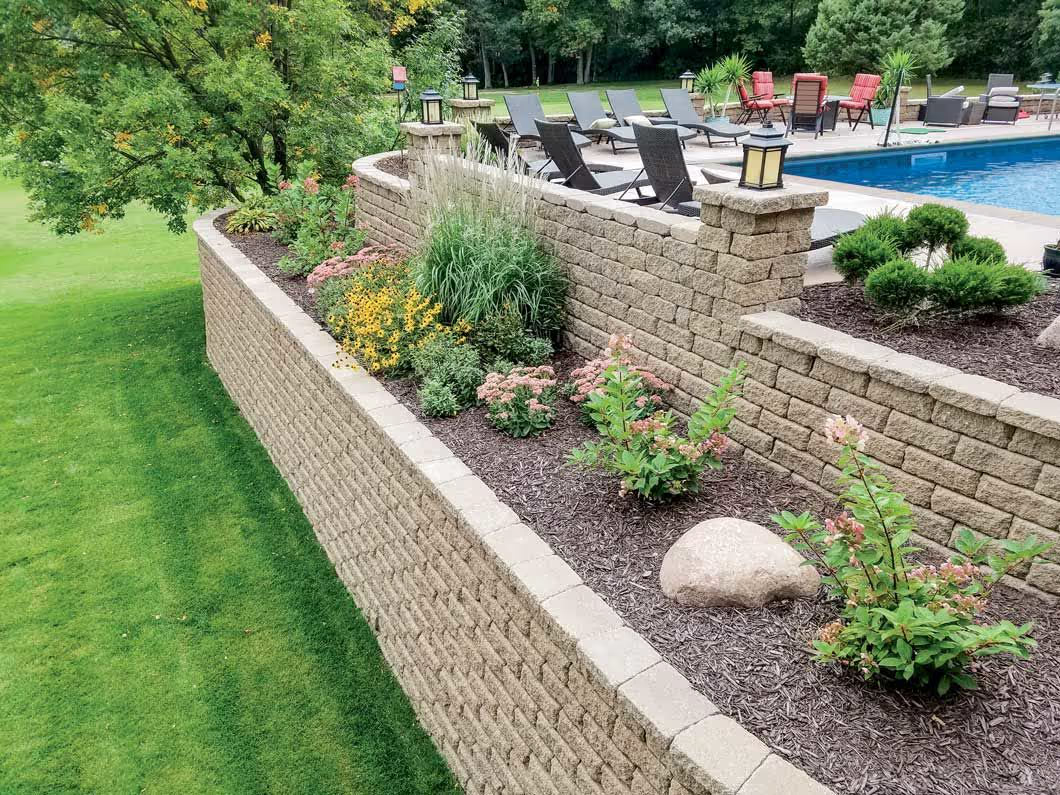
As I travel the country teaching the NCMA certification classes, I hear a number of questionable or oversimplified installation practices contractors use. I've come to believe there are some widespread myths in SRW installation. Which of these have you heard?
Myth 1 – The pins, clips or lips on the SRW unit help hold up the wall.
Things like pins, clips and lips do not stabilize or hold up a SRW unit. They are simply there for alignment, and to set the batter of the wall.

Myth 2 – SRW units used for gravity walls can go as high as the manufacturer's recommendation.
Be careful here. Many manufacturers do not add these 3 all important words "under ideal conditions." If the manufacturer says a wall can be built to 3' without grid, be sure there is no load, no rear slope, and no toe slope around the wall. These conditions change the geometry and load bearing capabilities of the wall.
Myth 3 – Geo-grid holds up the wall.
Geo-grid stabilizes the soil behind the wall. Soil is generally weak on its own and susceptible to settling and hydrostatic pressure that can cause movement in the wall. Geo-grid compacted into the soil creates a strong mass that holds firm. You could say that the SRW is really a fascia for the soil mass that is being stabilized by the geo-grid.
Myth 4 – The 1' of 3/4" clean stone directly behind the wall is a drainage layer.

Many engineers are now saying that if you have constant water in this area, you have bigger problems that need to be addressed elsewhere in the system. I choose to build my walls with a 3' layer of clean 3/4" stone behind the wall. This allows for good compaction and zero fines passing through the face of the block. Keep water away from this clean stone layer as best you can.
Myth 5 – Walls up to 2' high do not need a 6" embedment row of block.
All walls no matter what the height, require you to bury 6" of block for stability. You risk movement if you don't follow the design specifications even for a 2' wall. Below the bottom row of block, all walls require 6" of base extension, in front and behind the block. The leveling pad that the embedded block sits on must be compacted to 95% proctor density.
Myth 6 – Compaction on an SRW system is only done on the leveling pad.
Remember, an SRW is a total system which includes many components. The 3/4" stone layer and the infill soil layer that may stretch back behind the wall many feet, must be compacted to 95% proctor density. The compaction of these 2 layers strengthen the soil mass and help close the infill soil zone to water. Water infiltration is reduced 40% to 90% with compaction.
Myth 7 – All on-site soils can be used for infill soil on SRWs.
NCMA has specifications for infill soils for a reason. If the soil has too many fines (clay) it won't drain well and will heave, causing pressure behind the wall. That's why NCMA specifies no more than 35% fines passing the 200 sieve. NCMA also prohibits any stone larger than 4" because those boulders can work their way to the surface or to the back of the wall thru the freeze/thaw process.
Myth 8 – Several rows of wall block can be installed before backfilling.
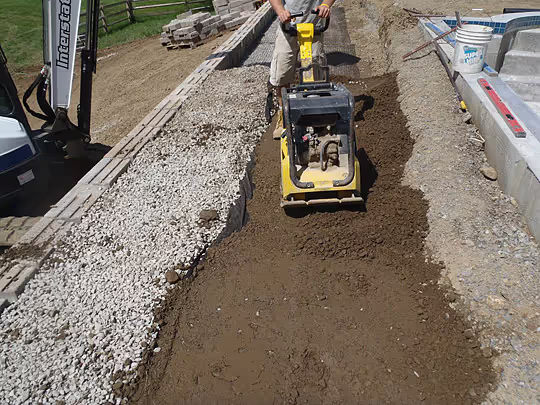
NCMA specifications call for walls to be built 1-block-row at a time. Soil lifts should be no more than 8". Compaction should occur when each soil lift has been completed. If you go over 8" you can't get the level of compaction you need, so the soil mass behind the wall is weak and excess water can get into the infill soil zone. For walls with a set batter, the set-back can actually pull the wall over if you don't install and compact backfill as you go. I've seen this happen. When using a flowable fill or an Anchorplex type of infill, consult the wall manufacturer or engineer for construction specifications.
Myth 9 – Geo-grid comes in several colors and can always be laid out parallel to the wall.
Wrong!! Geo-grid is never orange (see snow fence photo). It is always black, and can be uni-directional, meaning it only works either perpendicular or parallel depending on the manufacturer's specifications. Bi-directional geo-grids are designed to work both perpendicular or parallel. Be aware that geo-grids have different strengths. Don't cheat on grid strength or length.
Myth 10 – OSHA rules don't apply to residential jobs.
Again, wrong!! All OSHA rules apply to residential projects. The landscape/hardscape industry is number 4 on OSHA's list of most investigated industries. So be aware, big brother is watching.
Bill Gardocki is the owner of Interstate Landscape Co., Inc. in Londonderry, NH. He has been installing hardscapes for over 30 years. Bill has taught over 75 classes as an ICPI and NCMA Certification Instructor. He also provides hardscape installation seminars to sales reps in the hardscape and softscape industry. Contact Bill at Bill@InterstateLandscapeNH.com.
Project Profile
There's more where that came from!
Sign-up for our free newsletter to get industry news, advice from experts and project features in your inbox.


.jpg)

.avif)