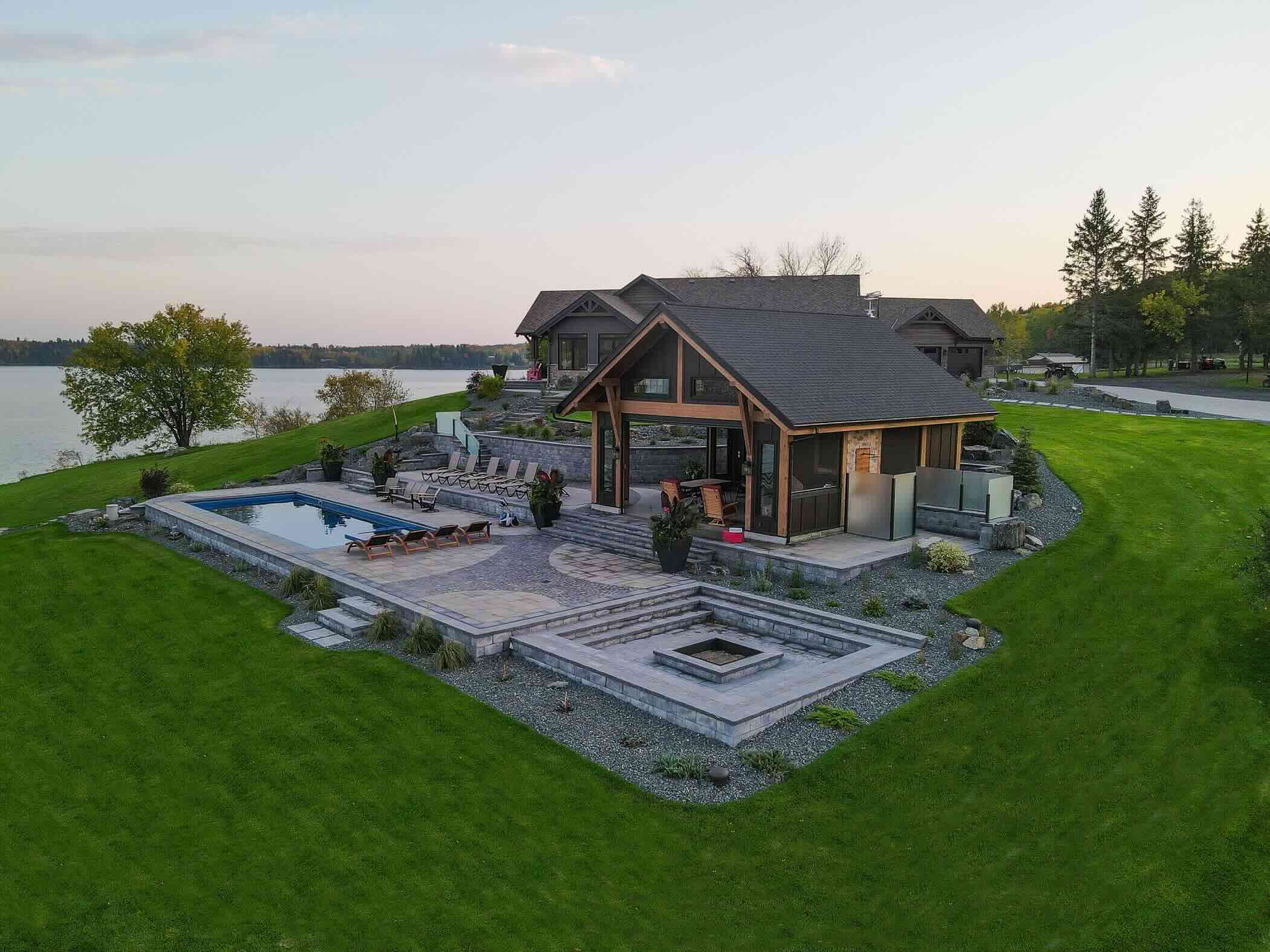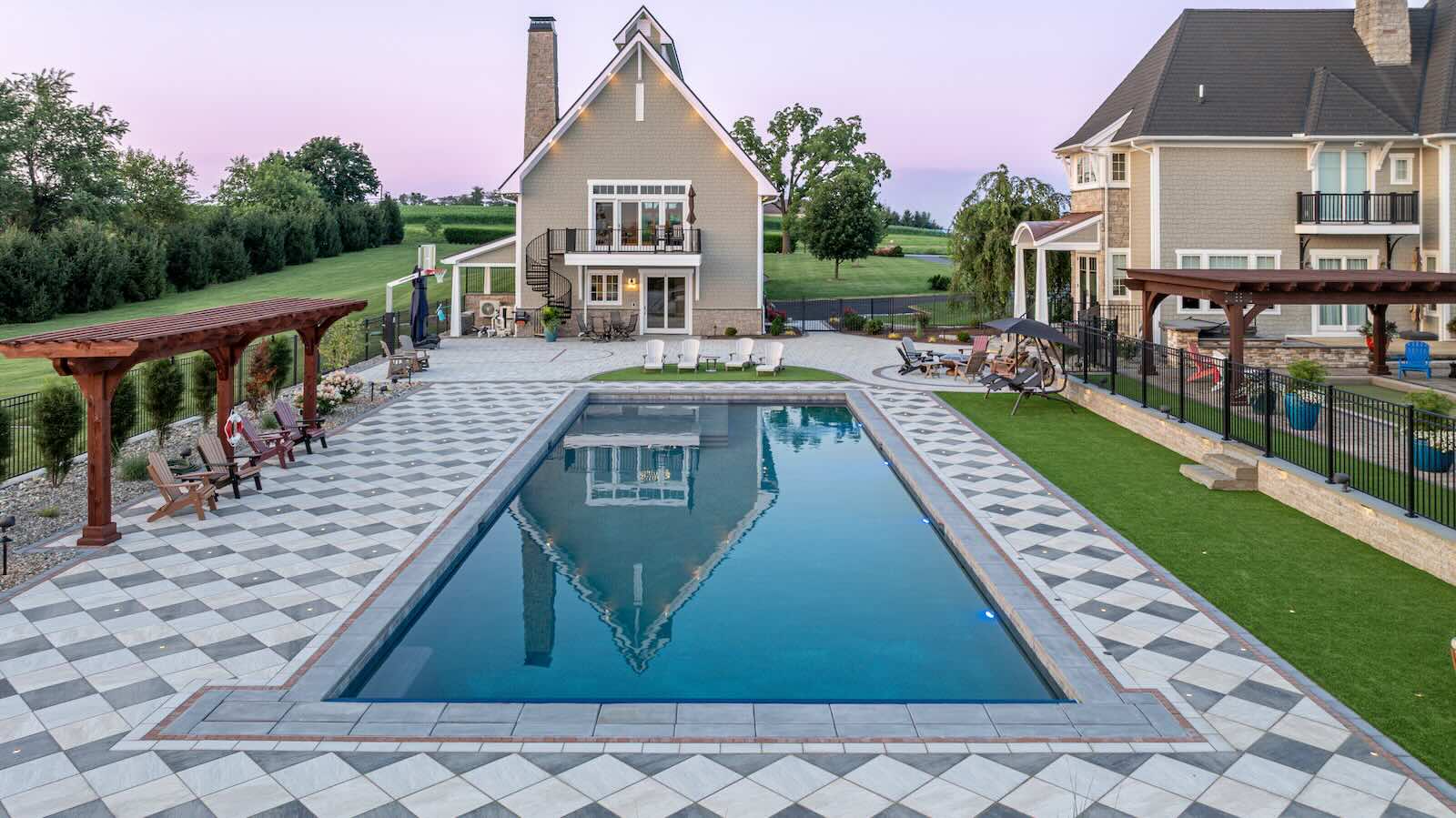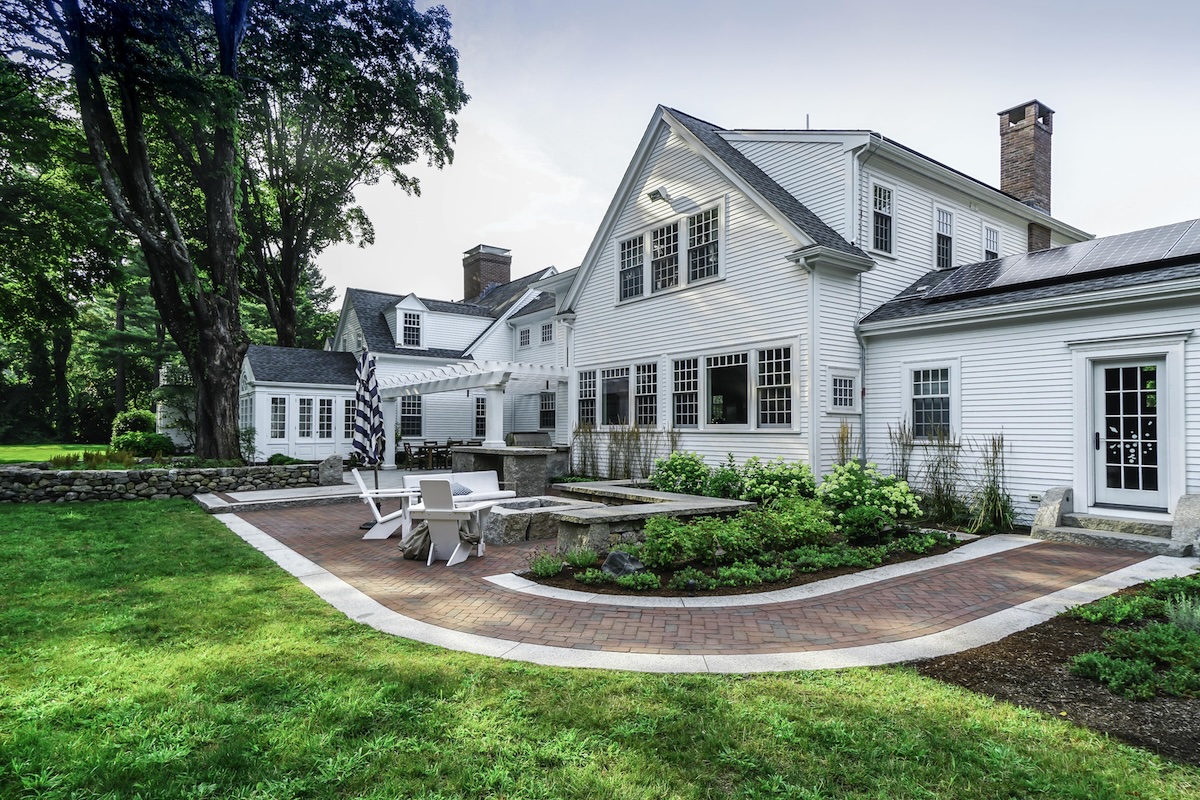
Sometimes the biggest opportunities in hardscape start with the smallest jobs. For Dan and Corey, owners of the landscape design-build firm Roots & Rocks, a career-defining project didn’t begin with a request for a massive outdoor living space. It began with a phone call to plant some rhododendrons.
“We got called in there on a recommendation from someone who was working on the property that had seen our work on Instagram,” Dan recalls. The client needed some basic planting done. But as Dan walked the site, he noticed the existing patio—an older bluestone installation—didn’t quite fit the space. “I just mentioned to the client on the way out, ‘If you’re ever interested in reimagining your backyard, just let us know.”
A few months later, that seed of an idea sprouted. The client called back, noting the idea had never left them. What followed was a nine-to-ten-month odyssey that would transform a backyard into an artistic masterpiece, dubbed "Project Opus," and fundamentally change the trajectory of Roots & Rocks.
Sourcing History
As the project commenced, the concept evolved from a standard hardscape into something far more significant. The clients began to view the project not just as a patio, but as a true extension of their home and a piece of art. To match this vision, the team turned to the historic aesthetic of the New England area, specifically Rockport granite, the stone used to build much of historic Boston.
“This wasn’t spec stone that we could send to a fabricator,” Dan says. Because the original quarries were no longer running, the duo drove all over New England—Maine, New Hampshire, and beyond—sourcing reclaimed materials from sites that held old stock.
Their diligence paid off when they found a granite block reclaimed from the renovation of the original Longfellow Bridge in Boston. “The countertop is actually an old bridge block from the original Longfellow,” Dan explains. While the clients were thrilled to have a piece of history in their backyard, matching that specific stone grain for the rest of the project required calling every contact in the region to find compatible quarry blocks.
.avif)
Industrial Power, Hand-Carved Finesse
The fabrication process was a marriage of heavy industry and fine art. To handle the massive raw blocks, the team collaborated with a fabricator who utilized a wire saw to mill quarry blocks into five-by-ten-foot slabs.
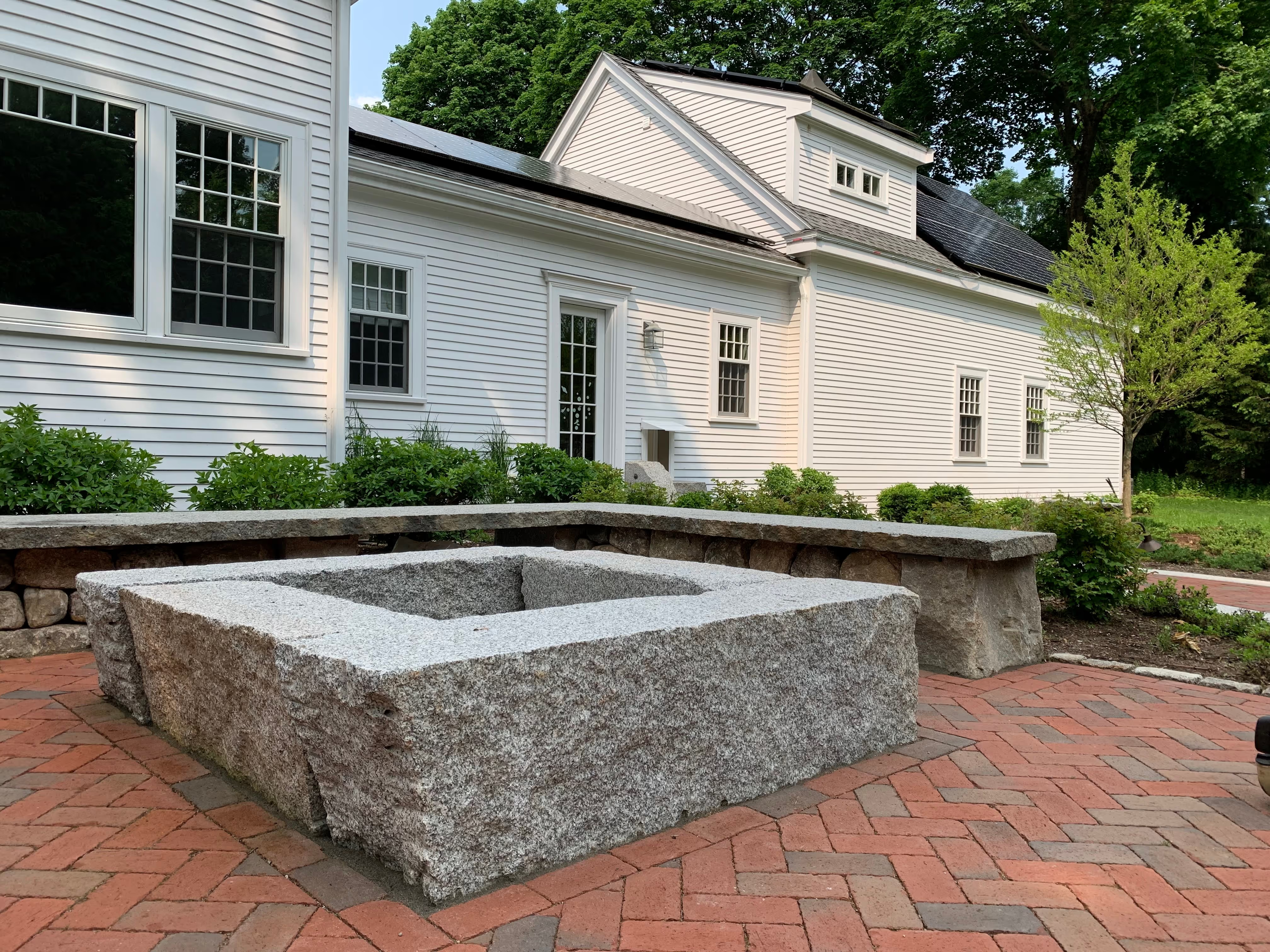
Once the rough fabrication was done, Dan and Corey took over the shaping on-site. They utilized thermal finishing with a propane oxygen torch to texturize the cut surfaces. By heating the stone to roughly 2,200°F, the microscopic air pockets in the granite popped, creating a non-slip surface that matched the natural aesthetic while eliminating the slick finish left by the wire saw. Crucially, they left the vertical faces of the stone untouched to maintain the “live edge” patina.
The installation required extreme precision. For the stair sets, the duo spent nearly 40 hours per set, hand-chiseling the stone to achieve a fit so tight that a piece of paper couldn't pass through the gaps. “We wanted the gaps to not even necessitate any sort of caulking,” Dan notes.
The Precision of Clay
While the granite stole the show vertically, the horizontal surfaces required a material that could offer geometric perfection to contrast the rugged stone. The team chose Pine Hall clay brick pavers.
The house featured a reclaimed brick front entry, and the team wanted to match that historic color. However, they needed modern precision. “We knew we were running a herringbone pattern,” Dan explains. “In the past, when the pavers were a little off, the herringbone got way off. We knew we needed a good product that was true in dimension.”
The gauged nature of the bricks allowed them to run perfect borders and soldier courses that aligned seamlessly with the granite elements. The team was meticulous about the layout, ensuring that every cut resulted in at least two-thirds of a brick remaining, avoiding small, weak "dips" that could fail over time.
One of the most striking visual elements is where the brick walkway meets the curved granite borders. To achieve a flawless curve, the team ran the pavers past the border line and then cut the radius in place using an eight-inch demo saw. By scoring a line and carefully undercutting, they achieved a tight, seamless transition that looked manufactured rather than field-cut.
Engineering the Impossible
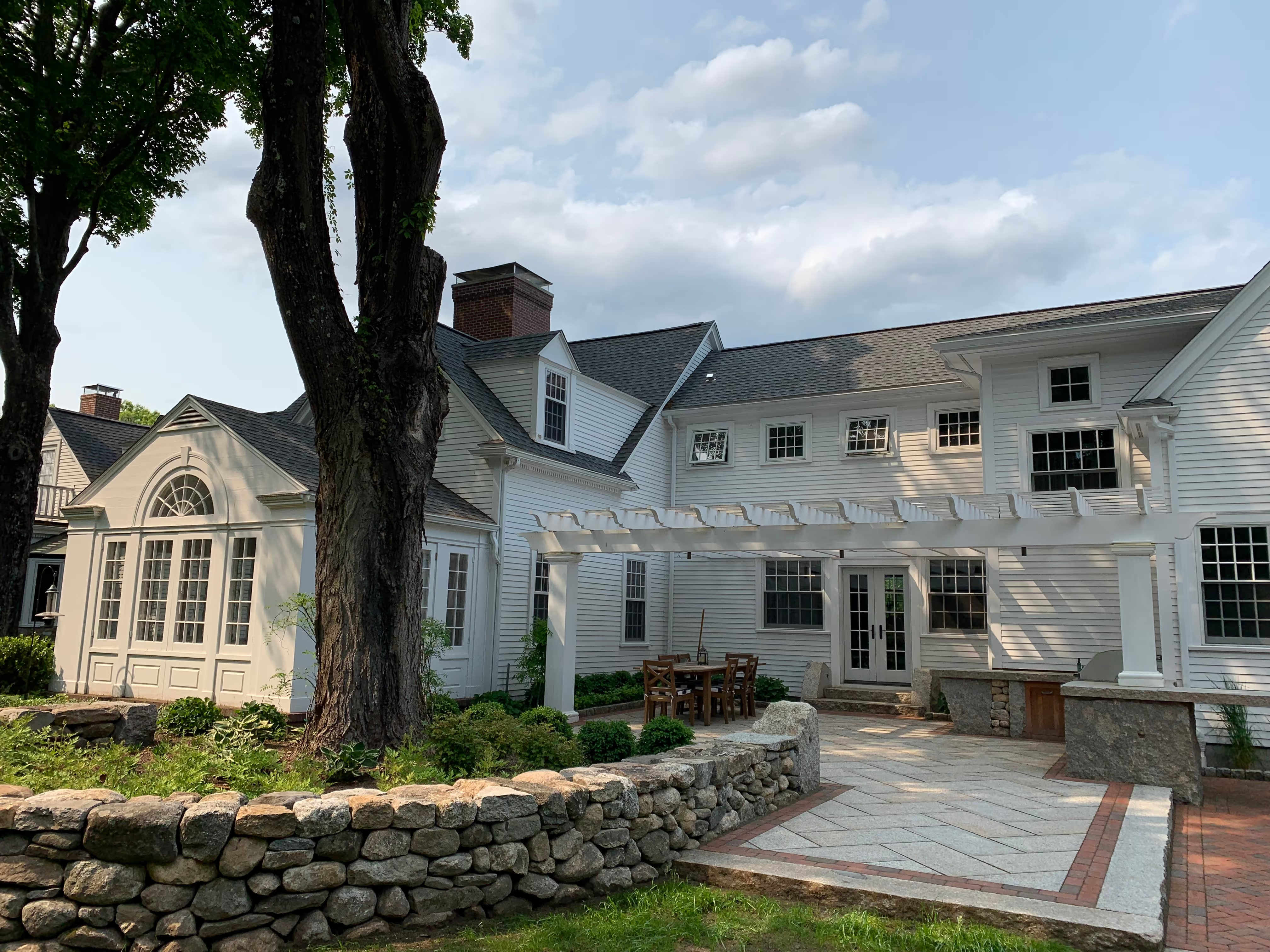
The build was not without its challenges. A carpenter installed a pergola that wasn’t positioned according to the specs, necessitating a tricky pivot in the countertop design.
To set the massive granite pieces under the pergola, Dan and Corey performed a “delicate dance” using a Toro Dingo and an excavator. With only an inch of clearance for the excavator arm, they utilized a vacuum lifter to maneuver the stones into place. “We used the whole Pave Tool system,” Corey jokes.
The curved sitting walls were another feat of engineering. Built as traditional dry stack walls with no mortar, they relied on gravity and friction for stability. To ensure the curves were perfect, the team used PVC pipe wrapped around rebar as a guide, raising it as the wall went up. The structure was back-battered, meaning it narrowed slightly toward the top for structural integrity. When the client asked about the strength of a wall without concrete, Dan and Corey climbed on top and did jumping jacks to prove its stability which quickly put that concern to rest.
Setting a New Bar
The HNA award winning Opus project did more than just upgrade a backyard; it set a new bar for the Roots & Rocks. The notoriety gained from the intricate stonework pivoted their business model entirely toward natural stone and large-format masonry.
“Our peers would look at the project and be like, ‘What the hell are you guys doing?’” Dan laughs. “It was just way out of the box.” By combining historical reclamation with modern fabrication and precise clay paver installation, they created a space that the homeowners viewed not just as a patio, but as a true work of art.
Project Profile
Company Profile
Roots & Rocks Inc.
Groton, MA
Dan Gladu, President
Corey Magliozzi, CFO
Project Designer
Dan Gladu
Project Manager
Corey Magliozzi
Project value (including both in-house and subcontracted work)
$500,000
Size of installation
10,000 sf (backyard zone 1)
In house work
Master plan design, stone walls, custom granite fabrication, outdoor kitchen, patio spaces, plantings, lawn installation, irrigation
Work done by others
Pergola, Finish Carpentry, Plumbing, Electrical
Year completed
2018
Services
Landscape Design & Build
Custom Stone Fabrication
Largest project
$550,000
Annual sales
$1 million
Employees
3 (2 co/owners) 1 employee. The “Opus” was completed before we had an employee.
There's more where that came from!
Sign-up for our free newsletter to get industry news, advice from experts and project features in your inbox.


.png)