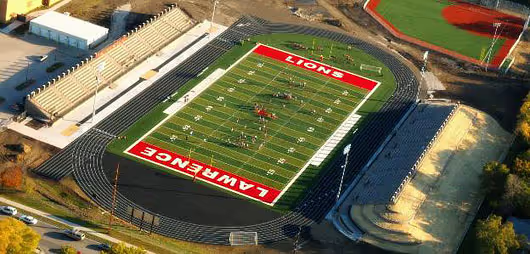
Timing, cost and aesthetics drove the decision to create the first (that we know of) bleachers built from SRWs.

The school district in Lawrence, KS had been kicking around the idea of building its own football fields for years. The 2 high schools had been sharing the football stadium at a local university which in recent years had fallen into disrepair. It was time to move forward. The district chose Landplan Engineering to develop designs for separate fields and stadiums for each school in addition to plans for soccer, softball and baseball facilities.
Landplan was in the early stages of the project when Capitol Concrete's Brad Minnick and Brian Hinck stopped by as part of a Versa-Lok Lunch & Learn visit. Afterwards they talked about the sports complex project noting that some areas around the fields would need retaining walls. At some point, someone mentioned shopping for aluminum bleachers.
Hmmm... bleachers. No reason they couldn't be built from retaining wall blocks too. So Brad threw the idea out there not expecting anything to come from it. His hosts politely entertained the idea before the meeting ended.
Aluminum loses to SRWs
In the months to come, Landplan Landscape Architect CL Maurer and Structural Engineer Jeff Martin were exploring aluminum bleacher options, and discovered that they couldn't be completed by their August 15, 2009 deadline. It would take a full year from the time a deal was signed before aluminum bleachers could be designed, manufactured and installed. The poured concrete footings alone would take over a month just to cure. The football season would be over.
There were other drawbacks to aluminum as well. CL says the surrounding neighborhoods were very concerned about noise. "They were envisioning huge noise from people jumping up and down on aluminum bleachers. And they were right, because aluminum reflects noise."
So, the Landplan team began to seriously explore the feasibility of segmental retaining wall bleachers. CL researched, hoping to learn from others who had designed similar projects. "But we couldn't find anything anyone has built that's anything like this. We still haven't."
CL says there were concerns that retaining wall bleachers might be uncomfortably cold to sit on. But they found that on cold, sunny days the blocks actually warm up much faster than aluminum. "And they retain the heat longer," explains CL. "So for an evening game, you still get some warmth out of that block."
Cost considerations
They pushed forward working on designs. Brad asked potential installers for help in developing preliminary labor cost estimates. Landplan verified the numbers and found that the cost for their retaining wall bleacher design was actually less than the enclosed aluminum bleachers they had looked into.
They had preferred enclosed aluminum bleachers because they didn't like the open designs which allow trash to fall through and provide a place for weeds to grow.
Aluminum bleachers (enclosed) $400 per seat
Aluminum bleachers (not enclosed) $200 per seat
Retaining wall bleachers (terraced) $250 per seat
Retaining wall bleachers (not terraced) $335 per seat
Three of the 4 bleacher sites had room to build a hill to support the bleachers, so the less expensive terraced design could be used. The 4th site, a smaller visitor bleacher, abutted a parking lot the school needed, so that bleacher has a 16' near-vertical rear wall, and no terracing. All in all, the retaining wall design would allow them to keep costs down while producing a far more attractive project.
Winning bidding
Landplan looked to Capitol Concrete to provide a list of qualified contractors. Brad came up with 4 or 5 who had the skills and capacity to complete a project of this size within the timeframe. Other contractors from around the country heard about the job and also submitted bids.
There were separate bids for each of the 4 bleachers, and the jobs were awarded to 2 contractors on Brad's original list. CL says Landplan would have hired 4 different subs if that's what they needed to do to get the job completed on time, or if the numbers worked out differently.
VF Anderson Builders, LLC won the 3 terraced wall bids. Tim Anderson at VF says he approached the bid like any wall quote then went back over it to look at what was different. "'How much extra time is this going to take?' This job took a lot of ballpark guessing. It helps that we're 1 of only a few companies in our area that could have done the job, and had the bonding capacity. A lot of wall guys don't do million-dollar jobs. Fortunately we do some general construction too so our bond line is higher."
BC Hardscapes, LLC won the 4-wall bleachers bid. Randy Grego of BC believes they won this bid because they had the right equipment to build it a little more competitively. Specifically, they have a 50' conveyor to deliver aggregate up and over the 16' wall face. Plus, they have an excavator and clamp attachment that can reach up over a tall wall and deliver retaining wall block where they need it with precision.
Time to produce
Now, the biggest challenge for Capitol Concrete was producing 130,000 retaining wall units fast enough to keep the contractors busy. Landplan chose a custom color so there was no stockpile sitting around. Brad says each contractor was asking for 4-5 loads a day delivered to the site 30 miles away. "We have the capacity to do that. But it definitely kept us on our toes for 16 production weeks."
To ease block production a bit, Brad says they provided standard gray block units to be used for all buried rows.
Become the grading guy's pal
With wall blocks on the way, the contractors started site work. VF Anderson's 3 terraced bleachers are built mostly on man-made dirt hills covered with 2' of clean drainage rock. The project excavation contractor placed and compacted the dirt. They also provided the drainage rock which VF placed and graded themselves.
Tim says, "Every time we'd go up a couple rows the grading guy would have to come back and put in some more dirt, level it off and compact it. So we tried to keep them ahead of us which is hard to do when it rains, and it rained a lot on this project.
Project timeline
April 2008 - Lunch & Learn initial discussions
December 2008 - bid secondary retaining walls around sports fields, and started construction
March 2009 - bid initial bleachers design (This design incorporated a large concrete box-culvert storage area beneath the bleachers and running the length of the structure. This design was rejected because it would have delayed the project.)
May 2009 - rebid, signed end of May, and started construction
August 2009 - bleachers completed
"We worked right through the rain. Our guys never stopped. But a grading contractor is going to disappear for about 3 days when it rains because they can't move dirt. It was really a credit to our foremen. They had to go and make friends, and make sure the grading guys knew when we needed them to be out there so we didn't have to stop."
The plans called for different fill material for the 4-wall bleacher constructed by BC Hardscape. The 4-wall bleacher is filled with AB3 gravel like a raised patio, and their contract called for them to install it themselves without involvement from the excavation contractor.
Pave now or pave later
Randy says BC Hardscapes built their bleacher walls to the top before installing pavers because it would have been too easy to damage pavers in the confined work area inside the 4-wall bleacher.
"Then we had about 20 men working on pavers with 8 saws going all the time. Each crew had a section they worked on and gang-handed the bricks and buckets of chips (used instead of sand) up to each other. We couldn't get any equipment in there so that's how it had to be done."
Tim says VF Anderson installed pavers just as soon as their wall builders were a few rows up and out of the way. "We have a wall expert, and a paver expert. They each have crews they like to work with. So the paver guy came right behind the wall guy, and when he wasn't putting pavers in he was out building another set of bleachers because of the timeline we had."
The 2 football fields were 5 miles apart, so VF crews could easily move crews from one site to the other. With luck, VF Anderson and BC Hardscapes will have more opportunities to move crews between the Lawrence sports complex sites. The school district also has soccer, baseball and softball fields that will get new bleachers as funding comes available.
When newcomers see these first SRW bleachers, CL says they frequently ask, "'Why did you spend the extra dollars?' Well, we really didn't spend extra dollars. It only looks like we did."
Photos
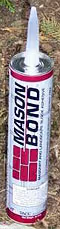
Given the dynamic pressure load from people running up and down on the seats - not just the stair treads - Landplan specified Mason Bond adhesive from ITW TACC be used throughout the project. Brad says, "I recommended Mason Bond because Mason Bond is 3 times stronger than most of the SRW adhesives out there, and they back that up with tests. It's a great option to have available."
CL adds, "It's amazing how well it's held up over the 6 months since the end of the project." Mason bond is especially appropriate for this application because it has received Greenguard Children & Schools Certification for safe, non-toxic use. It's also effective on wet and cold block.

Free State baseball and soccer fields also have retaining walls that use a tumbled Versa-Lok wall block.
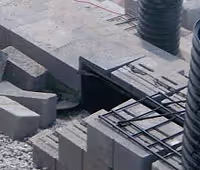
The black sheet-like product placed behind the seat wall is a flat drain (12" tall x 3/4" thick) that BC Hardscapes used in place of the 6" drain tile used in the other bleachers. CL says, "It's a lot easier to install because you don't have to cut a trench in the middle of your gravel. You just put it on the back of your wall and put your gravel behind it. We'll watch to see which drainage method works out better over the years."
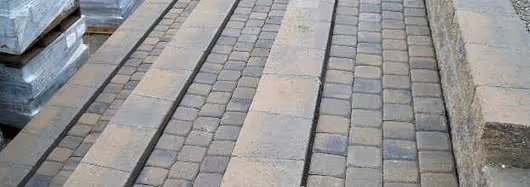
The pavers are set about an inch below the seat cap to the front, so if a drink is spilled onto the pavers it won't run over the seat. At the back of each seat cap there's an inch gap filled with drainage aggregate that flows water to the flat drains.
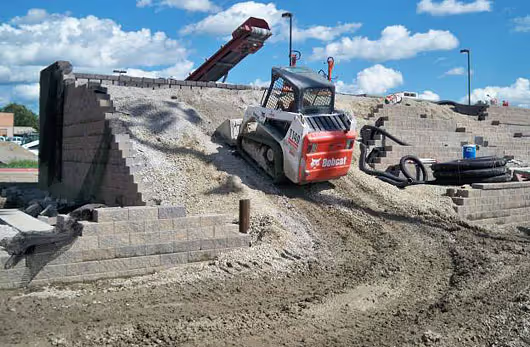
Access was the biggest obstacle for BC Hardscapes in building the 4-wall bleachers. They left one end open so they could drive smaller equipment in. Earlier in the project, they kept open a larger access area that allowed them to drive dump trucks right in as they built the back wall. Randy says they closed the larger access area off when the fill was about 8' high because it got too steep.
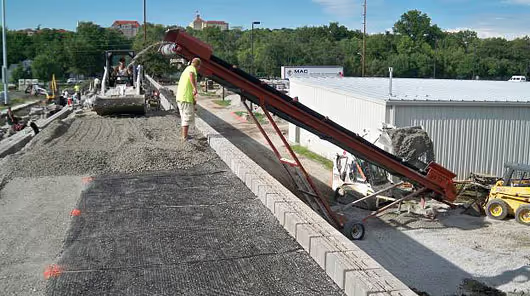
When the back wall and backfill area was 8' tall and too steep to drive in dump trucks, BC Hardscapes began using their 50' conveyor to deliver gravel over the back wall. The conveyer is run off skid-steer hydraulics. The skid steer also tows the conveyor around the site.
The conveyor did not move wall blocks. Those were delivered by skid steers until the work area became too narrow. Then the block was lifted over the back wall by an excavator with a clamp attachment.
The support system under each of the bleachers is interlaced with roll after roll of geo-grid. The 16' wall uses geo-grid every other block. Elsewhere there's geo-grid for each seat wall row which overlaps with geo-grid from the side walls.

The 16' drop from the top of the 4-wall bleacher was a huge contrast to the 30" drop at the top of the terraced bleachers. So, the fencing above that tall back wall received special attention. "We had to worry about who might be jumping up and down on those rails," reflects CL. "So we designed it to hold up against the '500 lb. gorilla.'"
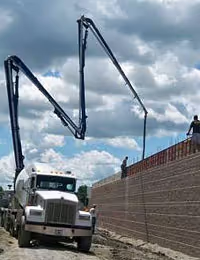
To secure the back fence, each of the column fence posts is set into a 3' x 3' reinforced concrete grade beam that runs the length of the structure behind the last bleacher and the top 3' of the wall. Randy says, "We had to stop wall building to form the entire beam. We used concrete panel forms and brought a concrete pump truck in that pumped the concrete in."

A Sleeve-It fence stabilization product awaits installation. The Sleeve-It was used extensively in the project. Fence posts are concreted into the tubing which is held firmly in place by compacted backfill over the horizontal support frame. Capitol 's Brad Minnick recommended using the product: "The Sleeve-It has engineering testing behind it so we know just how much of a load it will support. It's a lot better than the other stabilization methods I've seen. Anytime you can give something like that to an engineer, you do it."
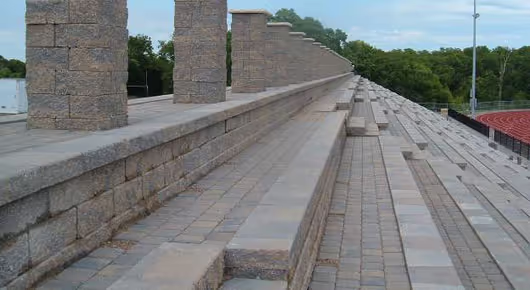
The initial drainage design left every 10th paver space in the row against the seat walls back-filled with 3/8 drainage rock. CL is developing plans to modify this before kids dig the gravel out.

The center of the bleachers is the highest point so water will drain in both directions. Most of the bleachers use 6" drain tile below each paved area which connects to larger drain tile and then underground storm sewers.

CL says they chose the 48" Ameristar Montage fencing shown on the front wall because the panels are jointed making them flexible and easy to install. "So your alignment can be a little bit off. You don't have to worry about jointing it or building something off site. You can rack them, stick them in the holes and go on."
Capitol Concrete is also producing the masonry units for the press boxes and concession/restroom buildings in the same custom color as the retaining wall blocks.

In addition to standard wall caps Capitol Concrete also created a new mold for special 6" cap units. Landplan wanted these thicker cap units for stair treads where they were sure to take a pounding.
Project Profile
School District of Lawrence, KS
4 sets of football field bleachers:
- 2 at Lawrence High School
- 2 at Lawrence Free State High School
34,030 sq ft pavers - Belgard Cambridge Cobble
65,051 sq ft walls and caps - Versa-Lok Standard
$1.6 million job
Designer & Project Manager
Landplan Engineering
Lawrence, KS
CL Maurer, Sr. Landscape Architect
Hardscape Supplier
Capitol Concrete Products
Lawrence, KS
Bradley C. Minnick, Hardscape Sales
Brian Hinck, Sales Manager
Hardscape Subcontractor - 1 bleacher without terraces
BC Hardscapes, LLC, Claycomo, MO
Randy Grego, General Manager
Largest job size: $3.5 million
2009 sales: $8 million
Service mix: 100% hardscape
Customer base: 90% commercial, 10% residential
Number of employees: 50
Hardscape Subcontractor - 3 terraced bleachers
VF Anderson Builders, LLC, St. Louis, MO
Tim Anderson, Member Manager
Largest job size: $2 million
2009 sales: $7 million
Service mix: 60% hardscape, 10% general contracting, 30% utilities and excavating
Customer base: 90% commercial 10% residential
Number of employees: seasonal 10-25
There's more where that came from!
Sign-up for our free newsletter to get industry news, advice from experts and project features in your inbox.


.png)