








Construction articles

Bill Gardocki
Geogrid is cheap insurance
Using geogrid is an easy way to prevent project failures – if you use it properly.
By Bill Gardocki, Interstate LandscapeI use geogrid and other geosynthetics on every hardscape project we do. Geogrid is the cheapest insurance policy you can buy for not having a failure. But, there are a lot of misconceptions about geogrid. Homeowners often ask, “Are you going to use that snow fence stuff to hold up my wall?” Of course, geogrid is not snow fence. But geogrid also doesn't hold up walls. Geogrid and geosynthetics stabilize our infill soils behind walls and under pavers.
The 2 key elements contractors must know about geogrid are:
- its laying direction, and
- its strength.
Most geogrid is unidirectional, meaning it must be laid out perpendicular to the wall. Use the grid strength your block manufacturer or site engineer specify, and use it at the length they specify. Grid length and grid spacing are determined by your soils and the SRW you chose.
Having a roll of grid leftover from one job doesn't mean you can use it on the next job. Soil conditions, wall height, and SRW selection are key factors that determine which grid strength to use.
Make an effort to develop a good relationship with a civil engineer that works with SRWs. An engineer is a good friend to have. If you are using grid in a non-engineered wall, the rule of thumb is that grid lengths should be at least 60% of the wall height.
Most manufacturers will do free preliminary wall designs you can pass on to your local engineer to speed the process and reduce the cost of getting a stamped plan. Talk to your sales rep about it. He'll likely want pictures of the site, a scale drawing, a soil sample, and he'll want to know what product you're using. Then he'll send everything off to his company's engineers.
Most of my residential stamped plans run between $700 and $1,000. Be sure you include the cost of the plan in your bid.
Bill Gardocki is the owner of Interstate Landscape Co., Inc. in Londonderry, NH. This year he celebrates his 40th year installing hardscapes. Bill has taught over 100 classes as an NCMA and ICPI certified instructor. He also provides hardscape seminars for dealer/contractor education days, and this year became the Landscape Construction instructor at his alma mater, the University of New Hampshire. Contact Bill@InterstateLandscapeNH.com
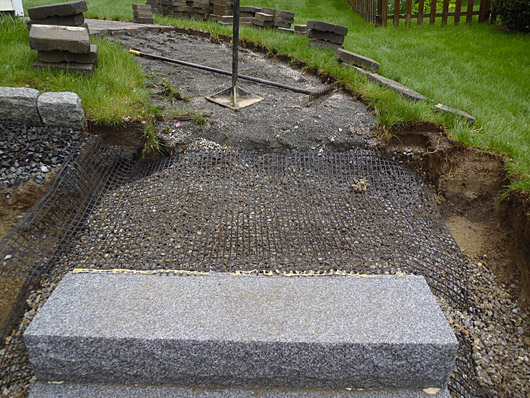
Here, geogrid is used to stabilize the #57 stone base beneath granite steps. A layer of grid is used under each step. Concrete adhesive is also used to prevent the steps from sliding forward from freeze/thaw pressures.
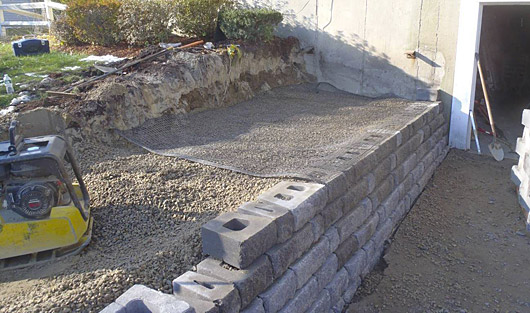
Geogrid should lay flat and be pulled tight. Measure grid length starting at the face of the wall.
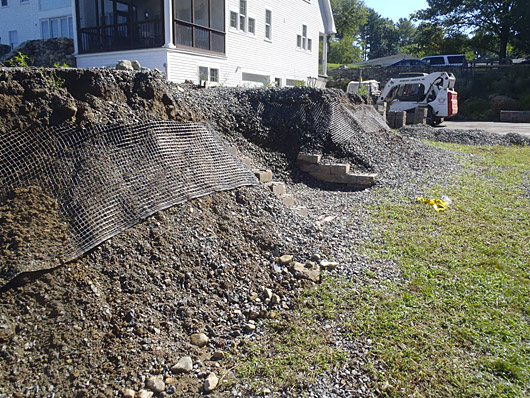
In this wall failure with the block now removed, geogrid was installed in the wrong direction.